

Frequently Asked Thermocrete® Questions
Can any chimney professional use Thermocrete® Ceramic Flue Liner?
Thermocrete® Ceramic Flue Liner can only be installed by a factory-trained technician. All installers are required to attend a comprehensive Thermocrete® training program. Each applicant is thoroughly screened prior to being accepted into our training program. Companies seeking certification bring their team of experienced chimney professionals to our facility for three days of intensive training on specialized equipment. After successfully completing the training, they receive official certification, assuring you that they are an authorized Thermocrete® installer.
If you are interested in offering Thermocrete® to your customers, you can apply to be an installer here.
Can Thermocrete® repair a chimney-fire damaged tile liner? What are the limitations?
Yes, Thermocrete® does repair heat-damaged clay tile. It fills cracks, binds tile together, closes eroded tile joints, and provides a heat-diffusing barrier that renders the total liner better than it was when it was first installed. Tests show that a Thermocrete®-repaired broken tile liner is gas-tight, remains intact during normal (sub-1200F) use, and is 99% less likely to re-crack during elevated chimney-fire temperatures of 1200-2100F. Thermocrete® will fill normal masonry joints, but for fire-damaged tile repair, only liners with no more than 1/8″ cracks be candidates for Thermocrete®. If tiles are broken apart, loose, or missing, you can’t use Thermocrete®. If tiles have holes larger than 1 inch in them or gaping cracks, you must not use Thermocrete®.
What about the need to downsize for many gas and oil applications?
This is an occasion that would require a different type of liner than Thermocrete®. The advantage of Thermocrete® in most cases is that it does NOT substantially downsize the flue.
Is Thermocrete® a zero-clearance liner?
Thermocrete® is not tested as a zero clearance liner for solid fuel. Thermocrete® possesses minimal insulation qualities and instead works by dispersing heat in a unique way
How does installation of Thermocrete® work in cold weather?
The problems you may encounter in cold weather are primarily related to the application process, not the finished product. Whenever you are dealing with water in below-freezing conditions, there are precautionary measures that need to be taken, however, if done properly, Thermocrete® can be sprayed in weather as cold as 20 F.
One of the benefits of Thermocrete® is that a few minutes after the end of spraying, many heating appliances can be fired to complete the cure, with no worries about plummeting nighttime temperatures.
How will Thermocrete® stand up to brushing during chimney cleaning, especially with flat-wire brushes?
Thermocrete® stands up very well to normal chimney cleaning. No special care is needed during cleaning. Although Thermocrete® is 5 times harder than cast-in-place liners and it has a remarkable capability for bonding firmly to chimney walls, however we do not recommend the use of rotary chains.
What about creosote wicking through tile liner cracks and remaining a hazard on the backside of existing tile?
Actually, the quantity of creosote that works its way through small tile cracks is inconsequential. We have never seen a dangerous quantity of creosote on the backside of minimally cracked tile. With a liberal coating of Thermocrete® in place, hot gases cannot penetrate the repaired tile to reach any creosote film. Thermocrete® provides a heat-diffusing barrier to minimize temperature rise on the back side.
How about eroded and spalled tile liners serving oil and gas appliances?
Thermocrete® is excellent in this situation. Since Thermocrete® is only as good as the substrate it is applied to, you should brush and peel away all loose liner materials first. The liner should generally remain, at minimum; 3/8″ thick at most spots. Any holes should be backed closely by masonry walls or filled with refractory materials. The Thermocrete® coating will then strengthen and bind together the old surface with a new acid-resistant and moisture-resistant seal.
Has Thermocrete® passed any official tests or certifications? What about U.L.?
Yes. Thermocrete® has undergone extensive testing by Ceram Research and Warnock Hersey / Intertek Testing Services. It was originally listed to the applicable sections of UL 1777 by Warnock Hersey in 1999 (#J99001572-231) then reevaluated, listed and labeled by Guardian Fire Testing Laboratories in 2011 to UL 1777 and ULC S 635 as a liner for Gas and Oil(GL90811/FI19311). Thermocrete® is also in compliance with NYS Building Code MC 801.16, item 3 and FGC 501.12, item 3. See the Thermocrete® technical data sheet for more information.
Is there any insulating capability for potential combustibles that are hidden without removing the tiles?
Thermocrete itself does not reduce the required clearance to combustibles. It is primarily a resurfacing and restoration system intended to repair and improve the integrity of the flue, not a zero-clearance or insulating system. If there are suspected hidden combustibles, those conditions would still need to be addressed separately to meet code requirements.
Does the spinning application cause uneven thickness when applied to a 9x13 or 9x17 given the shape?
On larger rectangular flues like 9x13 or 9x17, some variation in thickness can occur with a spin-cast application because the material naturally distributes differently in corners versus flat walls. With proper centering and application technique, the finish can still be very consistent overall.
What is the total thickness of the material when finished?
Finished thickness depends on the condition and size of the existing flue, but Thermocrete® applications are typically between 1/4” to 1/2" or more after completion, depending on how much material is required to restore the liner and achieve a smooth, continuous surface.
Is Thermocrete® zero-clearance rated?
Thermocrete® is not zero-clearance rated.
Thermocrete® is a sprayable ceramic flue resurfacing system designed to restore and improve the integrity of existing masonry chimney flues. While it provides excellent insulation, durability, and improved draft performance, it does not change the required clearance-to-combustibles established by building codes or appliance manufacturers.
Proper clearance requirements must still be maintained between the chimney exterior and any combustible materials. Every installation should be evaluated individually to ensure compliance with local building codes, NFPA 211 standards, and the appliance manufacturer’s specifications.
How will this product adhere to a flue that already has creosote in it?
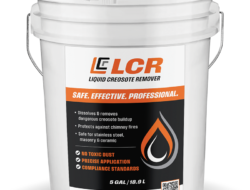
Nothing properly sticks to heavily sooted flue tiles. That’s why we always emphasize that the flue must be impeccably clean before any resurfacing or lining application. This is also why we introduced LCR (Liquid Creosote Removal), specifically designed to remove heavy soot and creosote buildup and properly prepare the flue surface for adhesion.
When Thermocrete® is applied properly, does it reduce the flue size by an inch in each direction?
Thermocrete® installation reduces the flue opening by a minimum of 1/4” on each side, resulting in a total flue size reduction of 1”.
Instead of using this product, could I just install a stainless steel liner?
On a rectangular flue, you often cannot install a liner large enough to properly serve the existing fireplace opening. In that situation, there are generally only two options:
- Remove the existing clay flue tiles (if feasible) and install the largest liner possible. The liner must then be insulated to meet code requirements.
- If the largest insulated liner still does not meet code requirements, the fireplace opening (firebox) must be reduced in size by reconstructing the firebox and/or smoke chamber to match the capacity of the liner.
Before proceeding, consider the scope of work involved:
- Demolition and removal of existing flue tiles
- Installation of a properly sized stainless steel liner
- Insulation of the liner to meet code requirements
- Potential reconstruction of the firebox and smoke chamber
- Masonry repairs and finishing work
- Permits and inspections, if required
The final cost will depend on:
- Height and accessibility of the chimney
- Condition of the existing flue
- Whether flue tile removal is possible
- Extent of firebox reconstruction required
- Labor hours involved
- Material costs for the liner, insulation, and masonry work
This can become a substantial project involving significant labor, material costs, and several days of work, depending on site conditions and code compliance requirements.